In the Field in Andean Patagonia
Dernière mise à jour : 28 mars
Excursions and Discoveries from the 50th Anniversary Congress of the Orthopterists’ Society
The congress celebrating the 50th anniversary of the Orthopterists’ Society, held in San Martín de los Andes (2026, March 8-12), provided not only a stimulating setting for scientific exchange but also an opportunity to explore in situ a region of remarkable ecological and scenic richness. Following the Society’s tradition, several post-congress excursions were organized to offer a brief overview of the region and, if desired, to continue scientific discussions in a field-based context. Northern Andean Patagonia is indeed a region of major interest for naturalists. Dominated by the Andes mountain range, it is characterized by a wide diversity of habitats—temperate Nothofagus forests, steppes, wetlands, and volcanic environments—which support an entomofauna that remains only partially explored. The excursions described below allowed participants to investigate a mosaic of remarkable ecosystems—glacial lakes, ancient temperate forests, and volcanic landscapes—while also addressing cultural and historical dimensions closely linked to the visited territories.
From San Martín de los Andes, the first excursion (March 13) followed the iconic National Route 40 (RN40), one of the most emblematic roads in Argentina. Stretching over 5,224 km, it runs from La Quiaca (on the Bolivian border) to Río Gallegos in southern Patagonia, making it the longest road in the country and one of the longest in the world. Weather conditions were excellent, with clear skies and abundant sunshine. A brief stop was made in Junín de los Andes, located about 40 km to the north. This initial segment of the journey revealed a marked landscape transition, from humid Andean forests to the more open formations of the Patagonian steppe, illustrating a pronounced ecological gradient.
Upon arrival in Junín de los Andes, a short visit highlighted the town’s main cultural features. The parish church—Santuario Nuestra Señora de las Nieves y Beata Laura Vicuña—stands out for its blend of Andean and European architectural influences and serves as a major pilgrimage site in Patagonia. The local handicraft market provided insight into regional production, particularly Mapuche craftsmanship (textiles, carved wood, and silver jewelry). Beyond its cultural value, the town lies at the interface of several ecological units, including Andean forests, riparian zones, and semi-arid steppes.

The excursion then entered the Lanín National Park, dominated by the imposing Lanín Volcano (3,776 m). The route followed Provincial Road 61 (unpaved), leading to Boca del Chimehuín, the outlet of the river originating from Lake Huechulafquen. From the lakeside viewpoint, the exceptional clarity of the water and the striking landscape were observed; the area is also renowned for fly fishing.
For approximately 30 km, the itinerary followed the lake and crossed forests of Araucaria araucana, remnants of ancient ecosystems dating back to the Mesozoic. A lunch stop was made at a small restaurant (Rayen Co), offering scenic views of the lake and surrounding mountains. Some participants sampled trout, a regional specialty associated with the cold, well-oxygenated waters of the Chimehuín River basin.
The journey then continued to the closest accessible viewpoint of the volcano. Conditions were ideal for observing and photographing the summit, whose southern face is adorned with a striking summit glacier. The day concluded on the shores of Lake Paimún, where the picturesque María Auxiliadora del Paimún Chapel reflects a harmonious blend of local and European architectural influences. Nearby, a small grove of araucarias provided a quiet setting. Among the time-sculpted trunks stood a modest rustic café, both charming and discreet, slightly precarious yet inviting relaxation. We enjoyed a hot drink while admiring the reflection of the mountains in the lake and the movement of birds among the branches. As clouds gradually obscured the summit, the day ended in a peaceful atmosphere before returning to San Martín de los Andes.


A second excursion (March 14) followed the scenic Seven Lakes Route, linking San Martín de los Andes to Villa La Angostura. This route crosses a succession of forested and lacustrine landscapes of great diversity. Although the weather was overcast and threatening, it did not detract from the quality of the excursion. The route initially follows Lake Lácar before entering dense forests dominated by several Nothofagus species (N. pumilio, N. antarctica, N. obliqua, N. dombeyi).
Notable features glimpsed along the route included the Pil-Pil viewpoint, offering panoramic views of Lake Lácar and the Chapelco range, as well as the Arroyo Partido, a hydrological curiosity where waters divide into two distinct oceanic basins. The route continued past a series of lakes—Machónico, Villarino, Falkner, Escondido, and Correntoso—before reaching the vicinity of Villa La Angostura. Due to weather conditions, the visit to El Mesidor residence — the early 20th‑century summer residence of the governor of Neuquén Province — was cancelled. The excursion then continued with a catamaran trip across Lake Nahuel Huapi, departing from Bahía Mansa.
After approximately 12 km of navigation, we reached the Quetrihué Peninsula and accessed the Arrayanes forest. This site is characterized by the dominance of Luma apiculata (arrayán), forming a dense and nearly monospecific forest—a rare phenomenon. The smooth, cinnamon-colored trunks and the advanced age of some individuals (up to 500–600 years) contribute to the uniqueness of this ecosystem. Wooden walkways protect the fragile root systems. The atmosphere is striking and almost unreal. The return journey took place under deteriorating weather conditions.


During the final two days (March 15-16), the planned excursion to Villa Pehuenia had to be cancelled due to adverse weather conditions. With only six participants remaining, we took the opportunity to further explore the cultural and historical heritage of San Martín de los Andes and its immediate surroundings.
The Lanín National Park Museum provides a valuable entry point for understanding the processes of exploration, land use, and conservation in the Andean region. Its permanent exhibition retraces the major stages of scientific and geographic exploration in northern Patagonia, with particular emphasis on Francisco Pascasio Moreno (known as “Perito Moreno,” meaning “the expert”). A naturalist, explorer, and pioneer of conservation in Argentina, Moreno—whose statue stands in front of the museum—played a key role in the establishment of the national park system, notably through land donations that contributed to the creation of Nahuel Huapi National Park.
The Municipal Museum of San Martín de los Andes offers a complementary, diachronic perspective on human occupation. Archaeological collections document the long-standing presence of Indigenous populations, particularly the Mapuche, whose ways of life were closely tied to forest and lacustrine resources. The transition to a modern town is illustrated through documents, objects, and photographs depicting colonization, infrastructure development, and the growth of tourism.
The La Pastera Museum, also known as the Che Guevara Museum, adds a political and Latin American dimension to this cultural itinerary. Housed in a former outbuilding (“pastera”) used during Guevara’s stay in 1952, it retraces the journey of the young Ernesto Guevara across the continent—famously undertaken on his motorcycle La Poderosa—prior to his revolutionary engagement. The exhibition highlights the social conditions he encountered during this formative journey, as well as the gradual development of a political consciousness shaped by inequalities across Latin America.
In a garden in the town center, near the COTESMA cultural center where the congress was held, a commemorative plaque marks the passage of the renowned Chilean poet Pablo Neruda, who fled political persecution in the late 1940s and crossed the Andes under difficult conditions, arriving in San Martín de los Andes under a false name. Along the lakeshore, a statue pays tribute to Miguel Andrés Camino, a regional poetic figure whose texts were set to music and performed by several artists, including Carlos Gardel, an iconic figure of tango and one of the most renowned singers in Latin America.
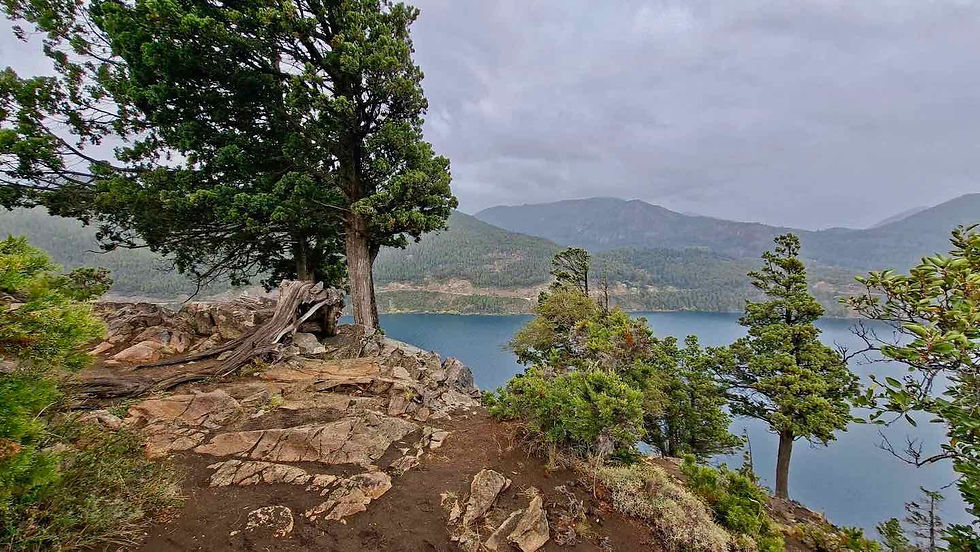
Finally, a hike along the Bandurrias viewpoint trail, overlooking both the town and Lake Lácar, provided a pleasant conclusion to this post-congress stay—despite a return to San Martín under heavy rain.


Commentaires