top of page

Journey to the Land of Thorns

  • 28 avr.
  • 2 min de lecture

Early Professional Years — Madagascar, 1969–1973


The allure of southern Madagascar has captivated vazaha—foreigners—for centuries. For more than three hundred years, explorers' accounts have portrayed the lands of the Mahafaly and Antandroy as an almost mythical region, where the sun, the thorny bush, and the customs of its inhabitants seem to have suspended time itself. These proud pastoral and warrior peoples long resisted both the Merina kingdoms of the central highlands and later French colonial rule. Even today, elders teach children to remain wary of outsiders.


No one returns unchanged from a journey to this remote frontier between reality and legend.


It was in this extraordinary setting that my professional life began, and the photographs gathered in this album bear witness to those formative years. I had the privilege of participating in a Food and Agriculture Organization (FAO) research program on the Malagasy Migratory Locust, one of the most destructive agricultural pests on the island.


My fieldwork first took me to the Betroka region in 1969–1970, and later to Beloha and Lavanono from 1971 to 1973, punctuated by shorter stays in Betioky-Sud, the home to Madagascar's Anti-Locust Center.


I invite you to explore this album, which brings together photographs from those early years—images of remarkable landscapes, memorable encounters, and glimpses of my first field research on the ecology of the Malagasy Migratory Locust. To accompany me on this journey into the Land of Thorns, simply follow the link below.
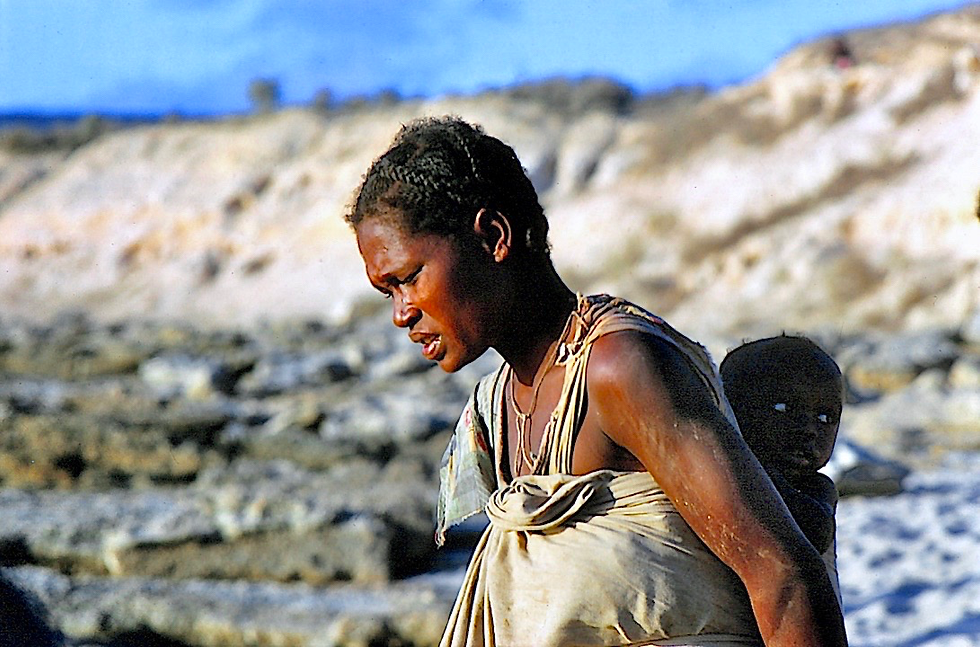


Fisherman's Wife, Lavanono.
Alkali (Barabay, between Beloha and Lavanono) — Alkali are anthropomorphic wooden sculptures, distinct from the better-known aloalo.
Descending toward the coastal plain of Lavanono—my first glimpse of what would become my field base from 1971 to 1973.

Fish bought from the fishermen of Lavanono are being cooked. The fire was lit using the traditional method of rubbing together two sticks of different hardness.
Aloe suzannae (= Aloestrela s.)
In the Beloha region, in Antandroy country, the ombiasy is a diviner and traditional healer, the guardian of the ritual and religious knowledge of the local community.
Alluaudia procera  (Didieraceae)                      (Local name: fantsiholitse)
Alluaudia procera  (Didieraceae) (Local name: fantsiholitse)

Aloalo are carved wooden funerary posts, sometimes painted, erected on graves during mortuary rituals in southern Madagascar.
Baobab in the Itambono corridor, between Betioky-Sud and Befasy, along the Mozambique Channel.
Aloalo in Antandroy country.

Commentaires


Featured Posts
Recent Posts
Search By Tags
bottom of page